

Benefits of Sending Child to Nursery

Dennis Y
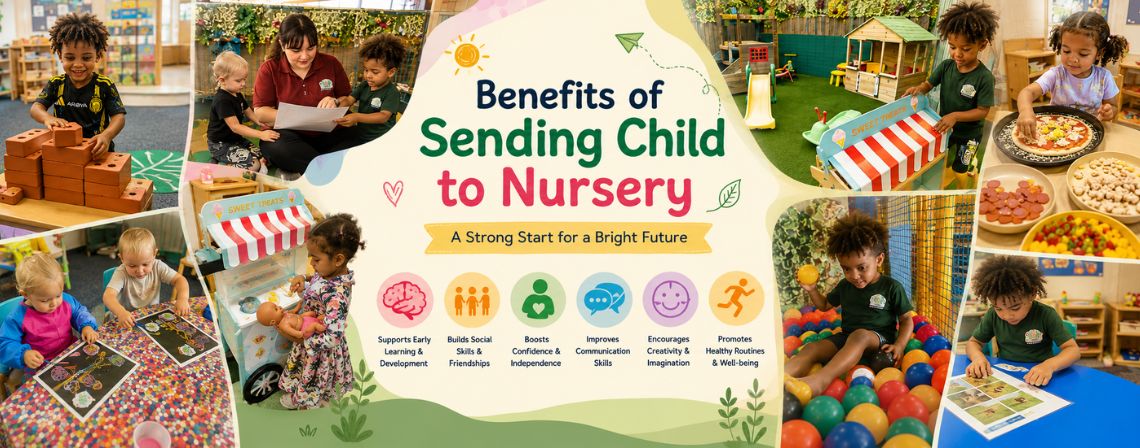
Choosing whether to send your child to nursery is one of the biggest decisions you will make in the early years. Some parents feel ready straight away. Others take a little more time to feel sure. Either way, the question is always the same: is it actually worth it?
The short answer is yes. But the full picture is far more interesting than a simple yes or no. The benefits of nursery go well beyond keeping your child occupied while you are at work. They shape how a child learns, speaks, plays, and relates to other people, not just at age three, but for years to come.
Let's break it down.
What the Research Says About the Benefits of Nursery
The strongest evidence for early years education in the UK comes from the Effective Pre-School, Primary and Secondary Education project, better known as EPPSE. This long-running study, funded by the Department for Education and led by the University of London, tracked over 3,000 children from age three through to their post-16 destinations.
The findings are clear. Children who attended pre-school showed better intellectual and social outcomes by the time they started school compared to those with little or no pre-school experience. The EPPSE study also found that attendance at pre-school predicted better outcomes in mathematics and science as late as Year 9.
That is not a short-term boost. That is an academic advantage that lasts well into secondary school.
A 2023 Department for Education survey found that 72% of children aged 0 to 4 in England were in some form of childcare during term time, with 63% attending nurseries or other formal settings. Most parents are not doing this out of convenience alone. They are choosing nursery because the evidence backs it up.
Here is a closer look at what that evidence actually shows, and what it means for your child day to day.
Social Skills: Learning to Be with Other People
One of the clearest benefits of nursery is what it does for a child's social development. At home, most children spend the majority of their time with parents, siblings, or a small group of familiar adults. Nursery changes that completely.
Suddenly, your child is in a room with a group of peers, all with different personalities, communication styles, and ways of playing. They learn to share. They learn to take turns. They learn what to do when someone else has the toy they want, and they learn it in a setting where trusted adults are there to guide them.
Research from Kids Inc Nurseries points out that children who have experienced nursery education are more likely to show advanced social behaviour, including cooperation and conflict resolution, and tend to build stronger relationships with peers. These are not skills you can teach from a book. They come from being around other children and working things out in real time.
This matters even more for children without siblings, or for those whose daily life at home is mainly spent around adults. Nursery gives them the peer contact that is so important for learning how the social world works.
Language and Communication: The Nursery Classroom Effect
Language development in the early years is rapid. Children's brains are building vocabulary, sentence structure, and communication patterns at a pace that never happens again in later life.
A high-quality nursery setting gives children far more varied language input than most home environments can provide. Staff engage children in conversation, storytelling, songs, group activities, and guided play, all of which expand vocabulary and build confidence in speaking. The Education Endowment Foundation has found that early education positively supports language and cognitive development, with guided play boosting oral language development in particular.
Children who start nursery also encounter language from their peers, which is different from adult language and equally important. They hear different accents, different words, and different ways of expressing ideas. All of this feeds into their own communication development.
For children where English is not the language spoken at home, nursery can play an especially important role in building confidence and fluency before they start school.
Emotional Development and Confidence: Growing Independently
Being away from home is hard at first for most children, and that is completely normal. But that difficulty is also where some of the most important developmental work happens.
When a child learns to manage a morning drop-off, to comfort themselves when a toy gets taken, or to ask an adult for help when they need it, they are building self-regulation skills. These are the emotional tools children need to manage their feelings and get on in a group setting.
Nursery World's research notes that children whose self-regulation and social skills need to catch up during their transition to school are less likely to settle well or reach their full potential. Nursery is where those skills get built, steadily and safely, before school places higher demands on them.
Children who attend nursery also tend to arrive at Reception with greater confidence away from their parents. They know what it feels like to be at a place without mum or dad. They know how to find a friend. They know where the snack is. That familiarity makes the transition to school much smoother.
School Readiness: The Head Start That Matters
School readiness is not about knowing your letters before Reception. It is about arriving at school with the emotional, social, and cognitive foundations to be able to learn.
Let's break it down: a child who has attended nursery will likely have experience of:
- Following a daily routine and moving between activities
- Sitting in a group and listening to an adult
- Working alongside other children on a shared task
- Asking for help and expressing their needs
- Managing short periods away from home
These are all skills that make the first weeks of school feel manageable rather than overwhelming. Research consistently shows children who attend nursery are better prepared for the transition to primary school, both socially and academically.
The University of London found that children who spent three or more years in nursery education could advance their academic attainment by up to a year compared to children whose parents kept them at home until age five. That is a meaningful gap, and it does not appear to narrow quickly.
Physical Development: Moving, Building, and Growing Strong
Play-based learning is not just fun. It is how young children develop physical coordination, strength, and spatial awareness.
At nursery, children paint, build with blocks, pour water, dig in sand, and use scissors. These activities build the fine motor skills that children need for writing. They run, climb, balance, and jump. These activities build the gross motor skills that support physical health throughout childhood and beyond.
Outdoor play plays a central role in this. The Early Years Alliance points out that physical activity releases chemicals that help children regulate their emotions, reducing anxiety and boosting self-esteem. [9] Even ten minutes of outdoor physical activity can have a measurable impact on a child's psychological wellbeing.
The EYFS statutory framework requires all registered early years settings to provide a balance of indoor and outdoor experiences, precisely because physical development is treated as one of the three prime areas of learning alongside personal, social and emotional development, and communication and language.
At Little Mowgli Nursery in Leyland, outdoor time is built into the daily routine. Children access the outdoor area in all weathers, picking up that connection between physical activity, nature, and learning that shapes healthy habits for life.
Cognitive Development: Building the Brain Through Play
Young children do not learn by sitting still and listening to instruction. They learn through hands-on experience: touching, sorting, building, asking questions, and testing ideas.
Nursery settings are designed around this. Activities that involve matching shapes, counting objects, working through simple problems, or exploring cause and effect all support cognitive growth in ways that feel completely natural to a child because they look like play.
A meta-analysis by Courtier and colleagues found moderate to high impacts on cognitive, social, and creative development in children who experienced structured play-based early learning environments. The Education Endowment Foundation's own evidence points to guided play delivering up to four months of additional progress in early skills.
These gains are not just academic. Cognitive development in the early years supports a child's ability to focus, to manage frustration, and to persist when something is difficult. These are the building blocks of any kind of future learning.
Structure and Routine: A Framework Children Can Rely On
Children thrive when they know what to expect. A clear, predictable daily routine gives children a sense of security that helps them feel calm enough to learn.
Nursery introduces that structure in a gentle, play-based way. Children learn what happens after snack time, when outdoor play is, and what the signal means when it is time to tidy up. Over weeks and months, that routine becomes familiar and reassuring.
This matters especially for children who have quite varied days at home. Moving into school is a significant transition. Children who are already comfortable with a structured day adjust to Reception's routines far more easily. As Kids Inc Nurseries notes, adapting to a routine provides a sense of security and familiarity, helping children feel more in control and reducing anxiety.
The Benefits of Nursery for Families Too
The benefits do not stop with the child. Parents gain something equally practical: the space and time to return to work, manage their own responsibilities, and, importantly, recharge.
Parental wellbeing matters for children too. When parents are less stretched, they tend to be more present and engaged at home. The government's expanded funded childcare hours, now at 30 hours per week for eligible working parents from nine months of age, have made nursery more financially accessible than at any point in recent history.
Families in and around Leyland can check current availability and session options directly through Little Mowgli Nursery, where both funded and full-fee places are listed with clear information for parents.
What to Look for in a Quality Nursery
Not every nursery delivers the same results. The EPPSE research found that the quality of the early years setting matters as much as attendance itself. A high-quality setting was defined by warm, responsive interactions between staff and children, a well-planned curriculum, and good communication with parents.
Here are four things to look for when choosing:
An Ofsted rating of Good or Outstanding. Ofsted inspects all registered nurseries in England and publishes its findings publicly. Currently, 96% of early years settings in England carry a Good or Outstanding rating.
A clear EYFS framework. All registered nurseries must follow the Early Years Foundation Stage. This covers the seven areas of learning, staff-to-child ratios, and welfare requirements.
A named key worker for your child. A key person builds a close relationship with your child, tracks their development, and keeps you informed. This individual relationship makes a real difference to how settled a child feels.
Outdoor access. Regular time outdoors is a legal requirement under the EYFS and a proven contributor to physical, cognitive, and emotional development.
5 FAQs About the Benefits of Nursery
Q: At what age should my child start nursery?
There is no single right age. Children can start from a few months old in a day nursery setting. Many parents choose to start between two and three years, when children are naturally more curious about the world and keen to interact with other children. All three and four-year-olds in England qualify for 15 free hours of funded early education per week.
Q: Do children who go to nursery do better at school?
The evidence strongly suggests yes. The government-funded EPPSE study tracked thousands of children and found that pre-school attendance predicted better intellectual and social outcomes at school entry. Those benefits continued to show up as late as Year 9 in mathematics and science.
Q: How does nursery help with language development?
Nursery exposes children to language-rich environments through storytelling, songs, conversations, and group activities. Children also learn from peers, which gives them exposure to language patterns that differ from adult speech. The Education Endowment Foundation has found that guided play in early years settings positively supports oral language development and vocabulary growth.
Q: My child is shy. Will nursery help or make things worse?
For most shy children, nursery helps. The gradual introduction to a group setting, with a consistent key worker and familiar routines, builds confidence over time. Children who find group interaction harder tend to benefit from early, structured opportunities to practise social skills in a safe and supportive environment.
Q: What is the difference between a day nursery and a preschool?
A day nursery typically cares for children from a few months old through to school age and is open longer hours to support working parents. A preschool usually takes children from around two or three and focuses more on early education with shorter sessions. Both follow the EYFS framework and can deliver government-funded hours for eligible families.
Leyland, PR25 2DY

.svg)