

Difference Between Playgroup And Nursery

Dennis Y
If you've started looking into early years childcare in the UK, you've probably come across both terms: playgroup and nursery. They sound similar. They both involve small children, activities, and learning through play. So what actually separates them?
The short answer is: quite a bit. The hours are different, the age ranges are different, the structure is different, and the purpose each setting serves for your child and your family is different. Let's break it down so you can make the right call for your little one.
What Is a Playgroup?
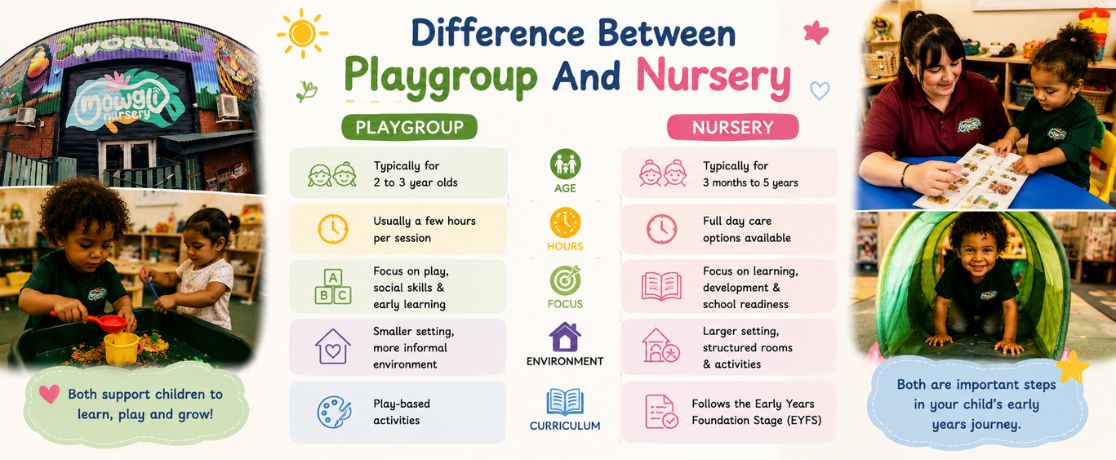
A playgroup is a part-time early years setting for children aged roughly 2 to 5. Sessions typically run for around 2.5 to 3 hours, either in the morning or afternoon, and usually only during school term time. Many playgroups operate from community halls, church buildings, or other shared spaces rather than purpose-built premises.
The focus in a playgroup sits firmly on social interaction and play-based learning. Children rotate between activities, share snacks, enjoy some free play, and usually finish with a story or song. The atmosphere tends to be relaxed and informal.
Playgroups are especially popular with parents who are at home during the day, since the short sessions fit around family life without requiring full-day childcare. Costs are usually lower than full nursery provision, and many places qualify for the government's funded childcare hours for 2 to 4-year-olds.
Here is something worth knowing: playgroups in England must still register with Ofsted and follow the Early Years Foundation Stage (EYFS) framework. This means they meet national standards for child welfare, staffing, and learning, even if the setting feels more informal than a nursery.
What Is a Nursery?
A day nursery provides childcare across a much wider age range and for much longer hours. Most nurseries accept children from as young as six weeks old right through to school age, and they typically open from around 7am to 6pm, Monday to Friday, all year round.
Nurseries cater especially well to working parents. Full-time and part-time places are both available, and rooms are usually divided by age group: a baby room, a toddler room, and a preschool room. This structured progression means your child moves through the setting as they grow, rather than changing settings entirely.
The curriculum in a nursery is more structured than a playgroup, particularly for the older children. Qualified practitioners follow the EYFS framework and plan activities around communication and language, literacy, mathematics, physical development, and more. There is a named key worker for each child who tracks their progress and builds a relationship with both the child and the family.
Staffing standards are tightly regulated by law. Under the EYFS Statutory Framework, nurseries must maintain specific staff-to-child ratios depending on age: one adult for every three children under two, one to five for two-year-olds, and one to eight for children aged three and over (or one to thirteen if a qualified teacher is present). Staff must hold approved childcare qualifications, and nursery managers appointed after January 2024 must hold a Level 2 Maths qualification.
Playgroup vs Nursery: A Side-by-Side Look
Here is a clear comparison to help you weigh things up:
Feature
Playgroup
Nursery
Age range
Typically 2 to 5 years
From 6 weeks to school age
Session length
2.5 to 3 hours
Full day, usually 7am to 6pm
Year-round?
Term time only
Year-round
Curriculum
Play and social focus
EYFS-structured learning
Cost
Generally lower
Higher, varies by setting
Is Ofsted registered?
Yes
Yes
Key worker system?
Not always
Yes
Best suited to
Parents at home; early socialisation
Working parents; full childcare cover
Which One Is Right for Your Child?
The answer depends on two things: your child's age and development, and what your family actually needs.
If your child is around 2 to 2.5 years old and you are at home during the day, a playgroup can be a gentle first step into group settings. Short sessions help young children build confidence without the intensity of a full day away from home. The informal environment suits children who are still getting used to being around other people their age.
If your child is 3 or older and ready for more structure, a nursery or preschool setting offers a fuller daily routine, more guided learning, and regular contact with qualified practitioners who plan activities around their stage of development. Research published by the EPPSE project, which followed around 3,000 children from early childhood to age 16, found that high-quality pre-school education was linked to better academic outcomes. The quality of the setting matters more than the type.
If you are a working parent who needs reliable full-day cover, a nursery is the practical choice. Playgroups do not offer full-day childcare and operate only during term time, which does not work for most working families.
If your child is ready for nursery but not quite at school age, a setting like Little Mowgli Nursery in Leyland provides both nursery and preschool care under one roof, meaning children do not need to move settings as they grow. The two dedicated rooms, Tigers and Giraffes, support children at different stages within a consistent, nature-inspired environment.
Does Your Child Need to Do a Playgroup Before Nursery?
No. Playgroup is not a compulsory step before nursery. Many children go straight into a nursery at age two or three without ever attending a playgroup, and they do absolutely fine.
What matters is whether the setting suits your child's readiness and your family's circumstances. Some children benefit from the shorter, gentler sessions of a playgroup before moving to a longer nursery day. Others settle into nurseries from day one without any issues.
Next steps: If you are unsure which route to take, book a visit to your local settings. Seeing the space, meeting the staff, and observing the daily routine tells you far more than any website can.
What About Government Funding?
Both playgroups and nurseries can offer government-funded childcare hours, so cost should not automatically push you towards one or the other.
From September 2024, eligible working parents in England can access 15 hours of free childcare per week from the term after their child turns 9 months old, rising to 30 hours per week for 3 and 4-year-olds whose parents meet the eligibility criteria. All 3 and 4-year-olds receive the universal 15-hour offer regardless of parental employment status.
Both registered playgroups and nurseries can deliver these funded hours, so it is worth confirming with your chosen setting which funding they participate in.
What the EYFS Means for Both Settings
Whether you choose a playgroup or a nursery, the Early Years Foundation Stage framework applies to both. The EYFS is the government's statutory framework covering children from birth to age five. It sets out what settings must do around learning, development, safeguarding, and welfare.
This means that regardless of whether a setting operates for two hours or ten, the staff must work within the same national standards. Ofsted inspects all registered providers and publishes reports online, which you can read before choosing a setting. You can search any provider at reports.ofsted.gov.uk.
What Parents Often Get Wrong
One common confusion: people sometimes use "nursery," "preschool," and "playgroup" interchangeably. In practice, they mean different things.
A nursery school is a standalone school for children aged 3 to 4, often attached to or part of a primary school. A preschool and a playgroup share some similarities but a preschool tends to place more weight on school readiness, with activities that build early literacy and numeracy alongside play. A day nursery, which is what most people picture when they say "nursery," provides full-day care across a wide age range.
At Little Mowgli Nursery, the setting functions as both a nursery and a preschool, so children receive full-day care alongside a structured play-based curriculum that prepares them for school at the appropriate stage.
FAQs: Playgroup vs Nursery
Q: At what age can a child start a playgroup in the UK?
Most playgroups accept children from age 2, though some start from 2.5 years. Sessions are short, usually 2.5 to 3 hours, and run during school term time only. They suit families where a parent or carer is available to collect after the session ends.
Q: Is a nursery better than a playgroup for my child's development?
Neither is automatically better. Both registered playgroups and nurseries follow the EYFS framework and support early development. The quality of the setting and the relationships children form with practitioners matter more than the setting type itself.
Q: Can my child attend both a playgroup and a nursery at the same time?
Yes. Some families use a playgroup for a morning session and a childminder or nursery for other days, depending on what funded hours they receive and what their schedule requires. Check with both settings that hours do not overlap for funding purposes.
Q: Do I have to pay for playgroup or nursery in the UK?
Not always. Government funding covers 15 hours per week for all 3 and 4-year-olds, and eligible working parents can access funded hours from 9 months old. Both playgroups and nurseries can offer these funded hours, though they may charge for extra hours or additional services like meals.
Q: How do I know if a playgroup or nursery is safe and high quality?
All Ofsted-registered settings in England are inspected regularly. You can read inspection reports at reports.ofsted.gov.uk. Visit the setting in person, ask about staff qualifications, and check the staff-to-child ratios for your child's age group before enrolling.
Leyland, PR25 2DY

.svg)