

Finding a Nursery Near New Longton

Dennis Y
Choosing the right nursery for your child is one of the first big decisions you make as a parent. It is not just about finding a place that fits your schedule, it is about finding somewhere your child will feel safe, settled, and genuinely happy to walk through the door each morning.
If you live in New Longton or the surrounding villages in South Ribble, you are in a good spot. There are nurseries within easy reach, and the area is well-served for early years care. But with a few options to compare and a fair amount of information to work through, it helps to know where to start.
This parent's guide to finding a nursery walks you through everything: what to look for, how Ofsted assessments work under the new 2025 framework, what government funding you may be entitled to, and the questions worth asking on your first visit.
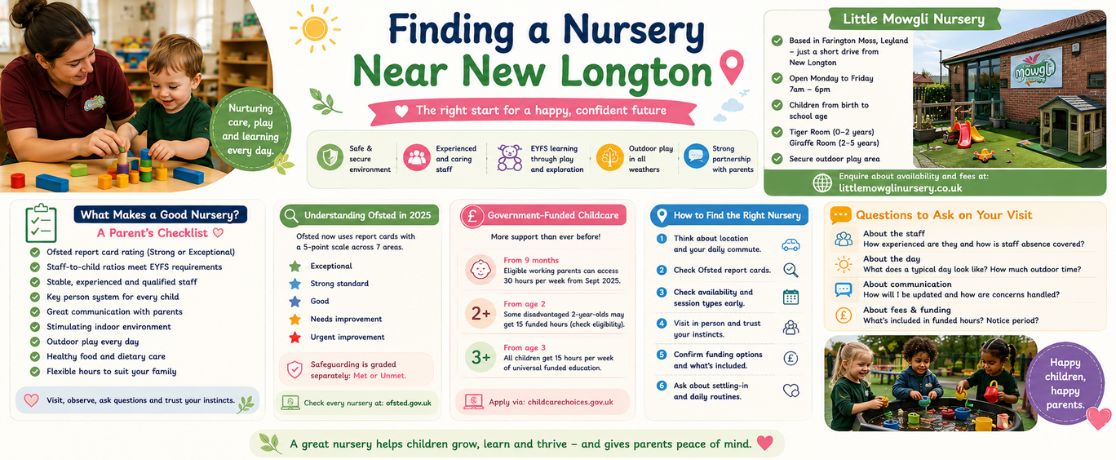
What Makes a Good Nursery? A Parent's Checklist
Before you start visiting settings, it is worth being clear in your own mind about what matters most to your family. Every parent will weigh things differently, but there are some non-negotiables that apply across the board.
Here is what to look for:
- Ofsted report card rating. Since November 2025, Ofsted issues report cards with a five-point grading scale across seven evaluation areas, replacing the older single-word judgements. Look for ratings of "Strong standard" or "Exceptional" across areas like safeguarding, curriculum and teaching, and children's welfare. Safeguarding is now listed separately as either "Met" or "Unmet."
- Staff-to-child ratios. The Early Years Foundation Stage (EYFS) statutory framework sets legal ratios. For children under two, the ratio is 1:3. For two-year-olds, it is 1:4. For three-to-five-year-olds, it is 1:8 in most settings. Ask how closely the nursery sticks to these in practice.
- Staff stability. High turnover in a nursery is a red flag. Children in early years thrive with consistent, familiar relationships. Ask how long staff have been in post.
- The key person system. Good nurseries assign a named key person to each child, someone who tracks development, builds a relationship, and communicates regularly with you.
- Communication with parents. Find out how the nursery keeps you updated. Do they use a daily diary, an app, or regular conversations at pick-up?
- The environment. Look at the rooms, the outdoor space, and the resources. Is the space stimulating but also calm? Are children engaged?
- Food and nutrition. Ask whether meals are provided on site, how they cater for dietary requirements, and whether children can bring packed lunches if preferred.
- Opening hours and flexibility. Check whether the hours genuinely match your working pattern, including early drop-off and late collection options.
Understanding the Ofsted Framework in 2025
Ofsted updated its inspection approach for early years settings in November 2025. The new framework introduces report cards with detailed narrative explanations alongside grades, designed to give parents a much clearer picture than the old system.
Under the renewed framework, inspectors assess seven areas: safeguarding, inclusion, curriculum and teaching, achievement, behaviour and attitudes, children's welfare and well-being, and leadership and governance. Each area is graded on a five-point scale from "Urgent improvement" through to "Exceptional."
Safeguarding is treated differently; it is assessed as either "Met" or "Unmet," and any setting where safeguarding is "Unmet" cannot receive anything other than the lowest overall grading.
You can check any nursery's report card on the Ofsted website at ofsted.gov.uk. It takes two minutes, and it is always worth reading the narrative sections, not just the grades.
Government-Funded Childcare: What You Are Entitled To
Funding has changed considerably over the past two years, and there is now more support available than at any previous point.
As of September 2025, eligible working parents with children from nine months old up to school age can now access 30 hours of government-funded childcare per week, representing a potential saving of up to £7,500 a year per child.
Here is how the entitlements break down:
- Universal 15 hours (ages 3–4): All children aged three and four are entitled to 15 hours per week of funded early education, regardless of whether their parents work.
- 30 hours (ages 3–4, working parents): Eligible working parents can access an additional 15 hours, totalling 30 hours per week.
- From 9 months to 3 years (working parents): From September 2025, eligible working parents can access 30 hours per week for children from nine months old, up to the start of school.
To be eligible for the working parent entitlements, each parent must earn the equivalent of at least 16 hours per week at National Minimum Wage and not exceed £100,000 adjusted net income per year.
The funding covers the childcare hours themselves but not extras. Providers can charge separately for meals, nappies, and optional services such as trips or specialist activities. Always ask your chosen nursery what is and is not included in the funded hours.
You apply for your funding code through the HMRC Childcare Service via childcarechoices.gov.uk, and you will need to reconfirm eligibility every three months.
Next steps: Check your eligibility on the Childcare Choices website, then apply as early as possible before your intended start term, as places fill quickly.
How to Find a Nursery Near New Longton: Practical Steps
New Longton is a small village in South Ribble, sitting just a few miles south of Preston and close to Leyland. For parents here, the most practical nursery options tend to be found in Leyland, Farington, and the surrounding area all within a short drive.
Here is a step-by-step approach to narrowing down your choices:
1. Start with location and commute. Think about whether the nursery sits on your natural route to work. A five-minute detour is manageable. A twenty-minute round trip in the opposite direction adds up quickly over a year.
2. Check Ofsted report cards. Search the Ofsted website by postcode to pull up registered settings near you. Read the full report, not just the headline grades.
3. Look at availability and session types. Many nurseries operate waiting lists, especially for the youngest age groups. Contact settings early ideally six to twelve months before you need a place.
4. Visit in person. No amount of reading replaces a visit. Observe how staff interact with the children already in their care. Trust your gut about the atmosphere.
5. Ask about your funding entitlement. Confirm the nursery is registered to offer funded hours. Ask whether they stretch your funded hours over 52 weeks or use them over 38 term-time weeks.
6. Think about settling-in. Good nurseries build in a gradual settling-in process. Ask how they approach this and how long it typically takes for children to adjust.
Questions to Ask on Your Nursery Visit
A nursery visit is your chance to gather information beyond what is on the website. Go prepared.
About the staff:
- How long have most of your practitioners been here?
- What qualifications do your staff hold?
- How do you handle staff absence? Do children always have a familiar face around?
About the day:
- What does a typical day look like for a child in the relevant age group?
- How much time do children spend outdoors each day?
- How do you support children who are slow to settle or anxious at drop-off?
About communication:
- How will you keep me updated on my child's progress?
- What is your process if my child is unwell or has an accident?
- How do I raise a concern if something worries me?
About fees and funding:
- Do you accept funded hours? Can I use them flexibly?
- What costs are not covered by funding?
- What is the notice period if we need to leave?
Little Mowgli Nursery: Serving Families from New Longton
For parents in New Longton, Little Mowgli Nursery is one of the closest options. Based in Farington Moss, Leyland, the nursery is a short drive from New Longton and is specifically listed as one of the local areas it serves.
Little Mowgli takes children from birth through to school age across two age-appropriate rooms:
- The Tiger Room caters for children aged 0 to 2, with a focus on sensory exploration, safe play, and supporting early development in a calm, nurturing environment.
- The Giraffe Room is for children aged 2 to 5, with dedicated areas for role play, creative activities, and early learning through a play-based approach.
The nursery also has a secure outdoor play area, which children access throughout the week in all weathers, a deliberate choice that reflects the setting's belief in the value of outdoor play for physical and mental wellbeing.
Little Mowgli's approach is rooted in the Early Years Foundation Stage framework, with a strong emphasis on individual development, positive relationships, and a home-from-home feel. Parents who have visited and enrolled their children through the nursery's website consistently mention how smooth the settling-in process has been and how communicative the team is.
The nursery is open Monday to Friday, 7am to 6pm, and you can enquire about availability and fees at Little Mowgli Nursery website .
What Age Can My Child Start Nursery?
Most nurseries in England accept children from as young as three months. Some, like Little Mowgli, take children from birth in their baby or toddler rooms.
The funded hours entitlements kick in at different ages:
- From 9 months: Eligible working parents can now access funded hours (30 hours per week from September 2025).
- From age 2: Some disadvantaged two-year-olds may qualify for 15 funded hours through a separate eligibility route based on benefits. Check the Childcare Choices website for the full criteria.
- From age 3: All children are entitled to 15 hours per week of universal funded education.
Final Thought
Finding the right nursery takes a bit of time, but it is time well spent. Use the Ofsted website, visit at least two or three settings, ask plenty of questions, and pay attention to how a place feels when you walk in. Your instincts as a parent are usually right.
If you are based in New Longton and looking for a nursery nearby, it is worth getting in touch with local settings early, checking what funded hours you are entitled to, and booking visits before the most popular places fill up.
FAQs: Finding a Nursery Near New Longton
1. How early should I start looking for a nursery near New Longton?
Start at least six to twelve months before you need the place to start. Good nurseries especially those with strong reputations fill up quickly, particularly for the youngest age groups. Visiting early also gives you time to compare a few settings without feeling rushed into a decision.
2. What is the difference between a nursery and a preschool?
A nursery typically accepts children from birth or three months old and operates full-day sessions. A preschool usually takes children from age two or three and offers shorter, more structured sessions. Many settings in the Leyland area, including those near New Longton, offer both, either in the same building or as separate rooms for different age groups.
3. Can I use my 30 funded hours at any nursery near New Longton?
The nursery must be registered with Ofsted and approved to deliver funded childcare in order to accept your government funding code. Most registered day nurseries are approved. Always confirm this with the setting before you enrol, and clarify whether they offer the hours over term time (38 weeks) or stretched across the year (up to 52 weeks).
4. What should I look for in a nursery visit to know if it is the right fit?
Watch how staff talk to and respond to the children already in the room. Notice whether children look settled and engaged. Ask about the key person system, how they communicate with parents, and how they support settling-in. If the staff seem happy and the children seem calm, that tells you a great deal about the culture of the place.
5. Does Little Mowgli Nursery accept children from New Longton?
Yes. Little Mowgli Nursery in Farington Moss, Leyland, actively welcomes families from New Longton and the surrounding villages. The setting is a short drive away and accepts children from birth through to school age. You can check availability and contact the team directly through their website.
Leyland, PR25 2DY

.svg)