

How Different Areas of Child Development Affect Each Other

Dennis Y
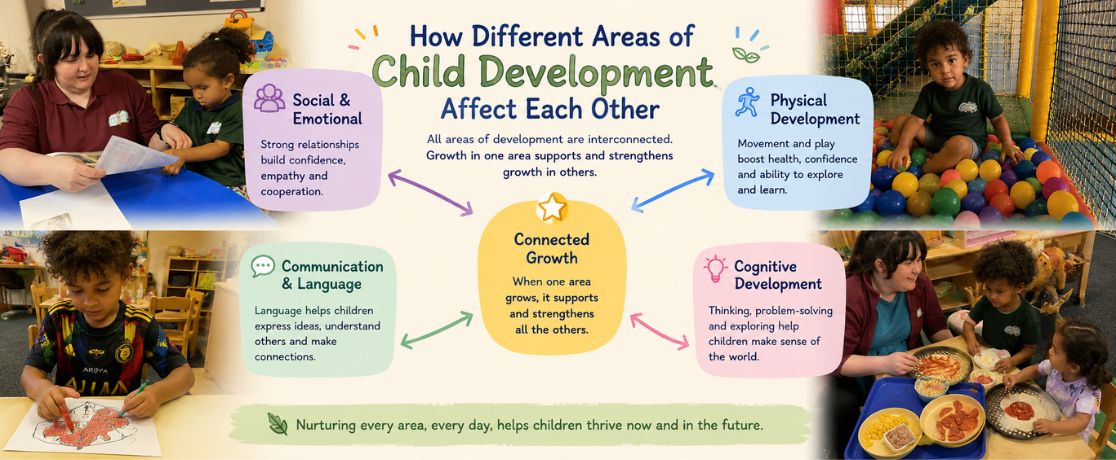
When parents watch their child take their first wobbly steps, it is easy to think of it purely as a physical milestone. But that first step is also a cognitive leap, an emotional triumph, and a doorway to new social experiences. Child development does not work in neat, separate boxes. The different areas of child development are woven together so tightly that progress in one almost always sets off a chain reaction in the others.
Understanding this can change how you support your child, from the activities you choose to how you respond when one area seems to lag behind.
What Are the Different Areas of Child Development?
Before we look at how they interact, it helps to name them clearly. Most early years frameworks, including the Early Years Foundation Stage (EYFS) used across England, recognise these core developmental domains:
- Physical development — gross motor skills (running, climbing, jumping) and fine motor skills (holding a pencil, doing up buttons)
- Cognitive development — thinking, problem-solving, memory, and attention
- Language and communication development — understanding and using words, listening, and expressing ideas
- Social development — building relationships, learning to share, working with others
- Emotional development — recognising and managing feelings, building confidence and resilience
Although these facets of child development may be categorised in many ways, experts have shown that they are all interconnected so closely related, in fact, that the most effective approach is generally to consider the child as a whole.
How Physical Development Connects to Cognitive Growth
Here is where things get interesting.
As children begin to crawl or walk, they gain new possibilities for exploring the world. This mobility, in turn, affects both their cognitive development and their ability to satisfy their curiosity.
Think about what happens the moment a baby learns to pull themselves up and toddle around a room. Suddenly they can reach a shelf, open a drawer, or touch a leaf on a plant they could only see from a distance before. That physical ability floods the brain with new sensory experiences, which builds neural pathways and supports learning. The body and the brain are in constant conversation.
Research shows that a disruption in either motor or cognitive development is more often associated with a disruption in the other than not. This is why early years educators pay attention to physical play just as seriously as they do to literacy activities. Running, climbing, and outdoor exploration are not breaks from learning they are part of it.
Fine motor skills follow the same pattern. When a child practises threading beads or squeezing playdough, they are not just building hand strength. They are also developing the concentration and spatial awareness that feed directly into early writing and mathematical thinking.
The Link Between Language Development and Social-Emotional Skills
Language is where the connection between developmental areas becomes particularly clear.
Language development influences a child's ability to participate in social interaction with adults and other children; such interactions, in turn, support further language development as well as further social, emotional, and cognitive development.
A child who can say "I am sad because you took my toy" is doing several things at once. They are using language (communication), identifying an emotion (emotional development), and navigating a social situation (social development). That single sentence represents three areas working together.
The oral language and vocabulary children learn through interactions with parents, siblings, and carers, and through high-quality interactions with educators, provide the foundation for later literacy and for learning across all subject areas, as well as for their social and emotional well-being.
Children who struggle to express themselves verbally often find social situations more frustrating. When you cannot tell a friend what you want, you may push or grab instead. This is not naughtiness, it is the consequence of one developmental area putting pressure on another. Supporting a child's communication skills is one of the most direct ways to support their behaviour and relationships too.
How Emotional Security Shapes Cognitive Learning
This is one of the most important connections for parents and educators to understand.
A child's security, both physically and in relationships, creates the context in which learning is most achievable across all of the developmental domains.
A child who feels anxious, unsettled, or unsafe cannot give their full attention to learning. Stress hormones interfere with the brain's capacity to focus, store memories, and solve problems. A persistent lack of responsive care in infancy results in the child experiencing chronic stress that may negatively impact brain development and may delay or impair the development of essential systems, including thinking, learning, and memory.
On the other side of the coin, a child who feels securely attached to trusted adults shows greater curiosity, is more willing to take risks, and bounces back more quickly from setbacks. Emotional wellbeing is not a soft extra; it is the foundation that the other areas of development rest on.
As children mature, their strong sense of attachment to significant people in their lives nurtures the motivation to interact with the world around them. Every time a key worker at a nursery responds warmly to a child's attempt to communicate, or a parent kneels down to celebrate a small achievement, they are building the emotional security that makes all other learning possible.
When One Area of Development Affects the Others: A Practical Picture
Let's bring this to life with a simple, everyday example.
Imagine a three-year-old at nursery during outdoor play. She runs across the grass, picks up a stick, and brings it to a friend. They decide to draw in the mud together.
In those two minutes:
- Her gross motor skills got a workout as she ran
- Her fine motor skills developed as she gripped the stick and made deliberate marks
- Her cognitive development was active as she made a plan and worked out how to execute it
- Her language skills were used as she negotiated with her friend about what to draw
- Her social development progressed as she shared a tool and took turns
- Her emotional development grew as she experienced the satisfaction of creating something together
For all children, but especially those in the earliest years of life, each area of development, perceptual, motor, physical, cognitive, social and emotional, approaches to learning, and language and literacy is related to and influences the others.
This is exactly why a nature-inspired, play-based approach to early years education is so well supported by research. When children play freely in rich environments, they develop across all areas at once, naturally and joyfully.
What Happens When There Is a Delay in One Area?
When something goes wrong in any one area, it has an impact on all the other areas. Where there is a delay or difficulty in one area of development, children's learning and progress in other areas can also be affected.
A child with delayed speech may find it harder to make friends, which can knock their confidence. A child with physical difficulties may miss out on the exploratory play that feeds cognitive development. A child dealing with emotional upheaval at home may find it harder to concentrate, which affects their learning across all subjects.
This is not cause for alarm, it is a reason to act early and thoughtfully. Research has found that children with poorer social skills at age four behaved more anxiously and aggressively at age ten, suggesting that supporting preschool children to get along well with others and pick up on social cues may benefit them in later childhood and adolescence.
Early identification and the right support can interrupt these knock-on effects before they take hold. That is one reason why good nurseries do not just track whether children are hitting individual milestones, but look at the whole child.
How Good Early Years Settings Support All Areas of Development Together
The best early years environments are designed with this interconnection in mind. Rather than treating cognitive, physical, and social development as separate goals to tick off a list, they create conditions where children develop across all areas simultaneously.
At Little Mowgli Nursery in Leyland, the approach is built around this principle. The nursery follows the EYFS framework, which recognises every child as unique and supports development across all its areas through play, exploration, and positive relationships. Their two dedicated rooms Tigers and Giraffes alongside their outdoor area, give children the space to move, create, communicate, and connect with others throughout the day.
Nature-inspired learning, access to the outdoors in all weathers, and a play-based curriculum all serve the same purpose: giving children the richest possible range of experiences so that all the different areas of child development get the stimulus they need, at the right time, in the right conditions.
Supporting Development at Home: What Parents Can Do
You do not need a specialist toolkit. The most powerful things parents can do are often the simplest.
Talk and listen. Narrating what you are doing, asking open questions, and giving children time to respond builds language and communication at the same time as it deepens your emotional connection.
Let them move. Physical play, especially outdoors, builds the body and the brain together. Do not rush children through activities that need physical effort.
Encourage free play. When children choose their own activities and follow their own interests, they practise decision-making, creativity, persistence, and social negotiation all at once.
Build routines. Predictable daily routines give children the emotional security that makes learning possible. Children who know what to expect feel safe enough to take risks and try new things.
Notice the whole child. If something seems off, look beyond the obvious area. A child who seems disengaged at storytime might be struggling emotionally, not cognitively. A child who is acting out socially might be frustrated by language difficulties.
Little Mowgli Nursery's family support resources and key worker system are designed to help parents stay closely connected to their child's development across all of these areas so that what happens at nursery and what happens at home work together, not in parallel.
Frequently Asked Questions
Q1. What are the main areas of child development, and why do they matter?
The main areas are physical, cognitive, language and communication, social, and emotional development. They matter because they shape a child's ability to learn, form relationships, manage their feelings, and thrive in school and life. No single area works in isolation, progress in one supports growth in all the others.
Q2. How does physical development affect a child's learning?
Physical development and cognitive development are closely linked. When children move, explore, and use their bodies, they build brain connections that support thinking, concentration, and problem-solving. Activities like climbing, drawing, and outdoor play all contribute to learning well beyond the physical domain.
Q3. Can a delay in one area of development affect other areas?
Yes, it can. A delay or difficulty in one area often puts pressure on others. For example, delayed speech can make social situations harder, which may affect a child's confidence and emotional wellbeing. Early identification and the right support can make a significant difference to outcomes across all areas.
Q4. How does emotional wellbeing affect a child's ability to learn?
A child who feels safe and secure is far better placed to concentrate, take on new challenges, and build relationships. Emotional stress actively interferes with cognitive function. Creating warm, trusting environments at home and at nursery is one of the most direct ways to support a child's learning.
Q5. What can parents do to support all areas of child development?
Talk and read with your child daily, encourage plenty of physical play outdoors, allow free play where they lead the activity, and build consistent, predictable routines. Staying in close communication with your child's nursery or key worker also helps, so that support at home and in the setting reinforce each other.
Leyland, PR25 2DY

.svg)