

How to Choose the Best Nursery Near Midge Hall for Your Child

Dennis Y
Choosing a nursery for your child is one of the most personal decisions you'll make as a parent. You're not just picking a place to drop them off, you're choosing where they'll spend their first years learning how to be curious, confident, and social. For families living in and around Midge Hall, there are a few good options within easy reach, but knowing what to look for makes all the difference.
This guide walks you through everything worth thinking about, from Ofsted ratings to settling-in policies, so you can make a choice you feel good about.
Why Location Matters When Searching for a Nursery Near Midge Hall
Midge Hall sits in the heart of south Lancashire, close to Leyland. That puts families within easy reach of several nurseries, but proximity alone shouldn't be the deciding factor. What matters more is whether the nursery's hours, ethos, and environment actually suit your family.
That said, a nursery that's close to home or your workplace does make the daily routine much easier to manage. A short drive means less stress for you and less disruption for your child, especially during those first few unsettled weeks.
When families in Midge Hall start looking, many end up considering nurseries in Leyland, Farington, and nearby villages like New Longton and Lostock Hall. The key is to treat the search seriously and visit in person before committing.
What to Look for in a Quality Early Years Setting
Ofsted Registration and Inspection Ratings
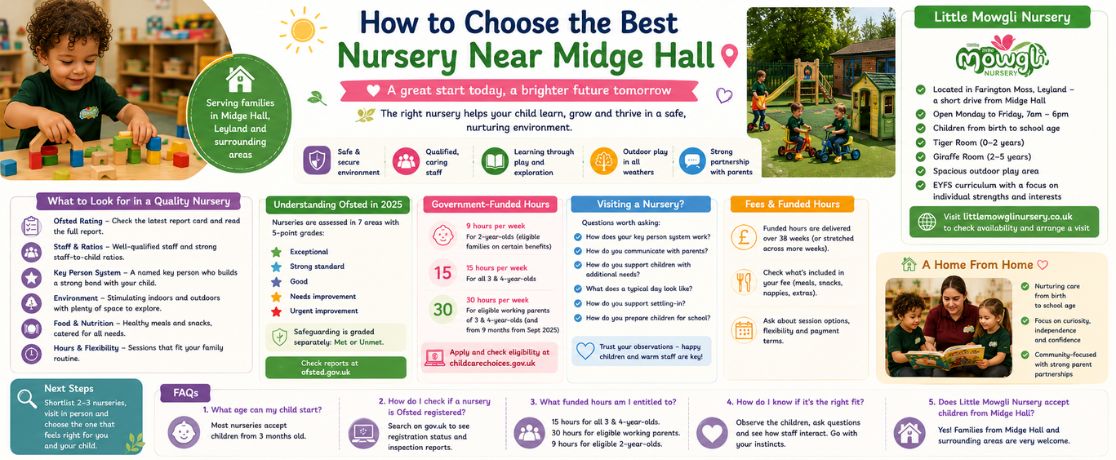
Every nursery in England must be registered with Ofsted and inspected against the Early Years Foundation Stage (EYFS) framework. Before visiting anywhere, check its most recent Ofsted report on the government's website. A "Good" or "Outstanding" rating gives you a baseline, but read the report itself rather than just looking at the headline grade. Inspectors comment on safeguarding, staff qualifications, leadership, and how well children's individual needs are met.
The EYFS sets out the standards all registered early years providers must follow. It covers seven areas of learning, from communication and language to physical development and personal, social and emotional growth. A nursery that genuinely understands and delivers against these areas will give your child a much stronger start than one that simply ticks boxes.
Staff Qualifications and Staff-to-Child Ratios
Staff ratios matter enormously, especially for younger children. In England, the legal minimum is one member of staff for every three children under the age of two, and one to four for two-year-olds. For three and four-year-olds, it's one to eight (or one to thirteen if a qualified teacher is present).
Ask how the nursery typically operates day to day, not just what the legal minimum allows. A setting that regularly runs at the lower end of acceptable ratios is going to be a different experience from one with consistently higher staffing levels. Also ask what qualifications staff hold ideally, you want to see a good proportion of the team holding Level 3 qualifications or above.
The Learning Environment
Walk through the rooms when you visit. Are they well-organised and stimulating without being overwhelming? Is there space for both active play and quieter, focused activity? Nurseries with separate areas for different types of learning tend to give children more opportunity to explore what interests them.
Pay attention to the outdoor space too. Time outside regardless of the weather supports children's physical development, builds resilience, and has a measurable impact on mental wellbeing. A nursery that values outdoor play rather than treating it as an afterthought is usually a good sign.
Settling-In Process
A good nursery won't just accept your child and expect them to get on with it. They'll have a structured settling-in approach that lets your child adjust gradually, usually through a series of shorter visits before they stay for full sessions. Ask how the process works and how staff communicate with parents during those early weeks.
How to Compare Nursery Fees and Funded Hours Near Midge Hall
Nursery costs in Lancashire vary depending on the provider, the hours, and the age of your child. Before you compare prices, make sure you understand your entitlement to government-funded hours.
Here is a quick breakdown of the current funded hours entitlements in England (as of 2025):
- 9 hours per week for two-year-olds whose families receive certain benefits
- 15 hours per week for all three and four-year-olds
- 30 hours per week for eligible working parents of three and four-year-olds
Funded hours are delivered over 38 weeks per year by default, though some nurseries offer the option to spread them across more weeks at a slightly reduced weekly amount.
On top of funded hours, most nurseries charge for additional sessions, meals, and extras. Make sure you ask for a full breakdown of what's included in any quoted price. Some nurseries include meals and snacks in their daily rate; others charge separately.
Visiting a Nursery: Questions Worth Asking
A visit tells you far more than any website can. Here's what to cover while you're there:
- What is the key person system and how does it work in practice?
- How do you communicate with parents throughout the day and week?
- How do you handle children with additional needs or dietary requirements?
- What is your behaviour guidance policy?
- How do you support children moving to school?
- What does a typical day look like for a child my child's age?
Trust what you observe as well. Are the children engaged and settled? Do the staff get down to the children's level and interact warmly with them? Does the room feel calm and purposeful? Your gut reaction during a visit is usually worth listening to.
What Makes a Nursery Stand Out: The Difference Between Good and Great
A nursery can meet every regulatory requirement and still not be the right fit. The settings that parents tend to stay loyal to share a few qualities that go beyond compliance.
They treat every child as an individual. Rather than running every child through the same activities, they observe what each child responds to and build on it. This takes more skill and effort, but it produces noticeably better outcomes.
They communicate openly with families. Regular updates, honest conversations about how your child is settling, and a genuine willingness to hear your concerns are signs that staff see parents as partners rather than customers.
They have a clear ethos. Whether that's a focus on nature, play-based learning, or community, a nursery that knows what it stands for tends to deliver more consistently than one that tries to be all things to all people.
They feel like a second home. The physical environment, the warmth of the staff, and the overall atmosphere should make both you and your child feel comfortable. A child who genuinely looks forward to going to nursery is a child who's thriving.
Little Mowgli Nursery: Serving Families from Midge Hall and the Surrounding Area
For families in Midge Hall looking for a nursery close to home, Little Mowgli Nursery in Leyland is well within reach. Located on Tomlinson Road in Farington Moss, it explicitly welcomes children from Midge Hall alongside families from Leyland, Longton, Lostock Hall, Bamber Bridge, and many other nearby communities.
The nursery operates two dedicated rooms: the Tiger Room for children aged 0–2, and the Giraffe Room for children aged 2–5. The Tiger Room is designed around the needs of infants and toddlers, with soft textures and calm, stimulating experiences. The Giraffe Room caters to older children with areas for role play, creative work, and early learning activities.
Both rooms benefit from access to a spacious outdoor play area, which reflects the nursery's commitment to outdoor learning in all weather conditions. The setting takes inspiration from nature and encourages curiosity, independence, and a genuine love of the outdoors as part of its day-to-day approach.
Little Mowgli Nursery is open Monday to Friday, 7am to 6pm, with wrap-around care available from 7:00am and through to 6:00pm for families who need flexibility. Full-day sessions run from 7:30am to 5:30pm at £60, with half-day options available at £35. Funded hours are accepted over 38 weeks, with the option to stretch them across 51 weeks for families who stay year-round.
The nursery follows the Early Years Foundation Stage curriculum and focuses on each child's individual strengths and interests. Its community-focused approach, home-from-home atmosphere, and attention to cultural and individual needs come through clearly in the reviews families have left.
Next Steps: How to Shortlist and Choose
Once you've done your research, narrow things down to two or three settings that look promising, then visit each one. Don't rely purely on word-of-mouth recommendations, what works perfectly for one family might not suit yours.
After visits, compare how each setting measured up against the things that matter most to you: the environment, the staff, the settling-in process, the communication style, and the overall feel. Then make the decision that feels right for your child.
If you're based in Midge Hall or nearby, it's worth contacting Little Mowgli Nursery to arrange a look around. They're a small, community-focused setting in a convenient location, and seeing the rooms in person is the best way to get a feel for whether it's the right fit.
FAQs: Finding the Best Nursery Near Midge Hall
1. At what age can my child start nursery near Midge Hall?
Most nurseries accept children from as young as three months old. Government-funded hours become available from age two for eligible families and from age three for all children. It's worth registering your interest early, as popular settings in the Leyland area can fill up quickly.
2. How do I check if a nursery near Midge Hall is Ofsted registered?
You can search for any registered early years setting using the Ofsted provider search tool on the UK government's website (gov.uk). It shows current registration status and links to the most recent inspection report, including grades for overall quality and safeguarding.
3. What funded hours am I entitled to for my child in Lancashire?
Most three and four-year-olds in England are entitled to 15 funded hours per week. Eligible working parents may qualify for 30 hours. Two-year-olds in families receiving certain benefits may also qualify. Lancashire County Council's Family Information Service can confirm your entitlement.
4. How do I know if a nursery is the right fit during a visit?
Watch how staff interact with the children already there. Notice whether the rooms feel calm and well-organised. Ask about the key person system and settling-in process. A setting where children look engaged and staff seem genuinely warm is usually a reliable indicator of a good experience.
5. Does Little Mowgli Nursery accept children from Midge Hall?
Yes. Little Mowgli Nursery in Leyland explicitly welcomes families from Midge Hall and other surrounding areas including New Longton, Lostock Hall, Bamber Bridge, and Longton. You can find full details and availability at their website.
Leyland, PR25 2DY

.svg)