

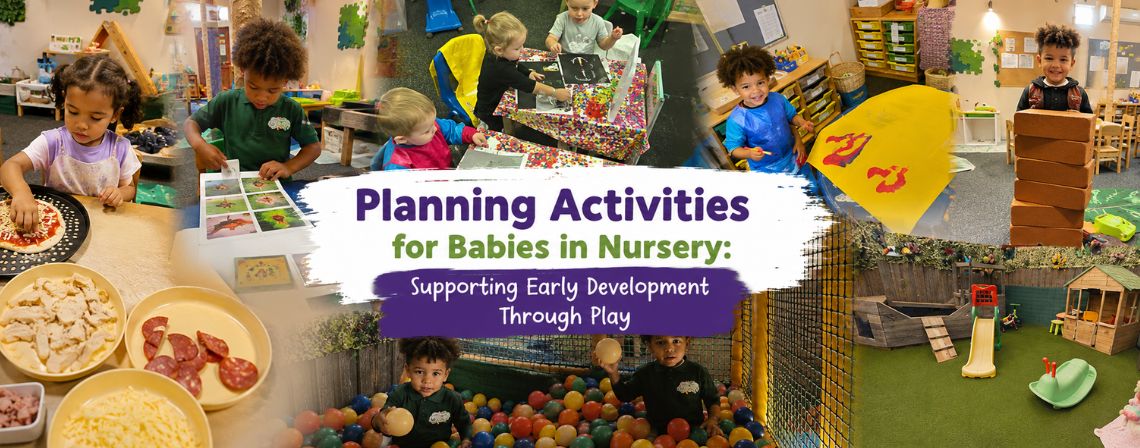
Planning Activities for Babies in Nursery: Supporting Early Development Through Play

Dennis Y
Babies are learning every single moment. Long before they can speak, walk, or tell you what they need, they are taking in everything around them through touch, sound, sight, and movement. That is why planning activities for babies in nursery is one of the most important things a good early years setting does.
Get it right and you give babies a foundation they carry with them for life. Get it wrong, or skip it entirely, and you leave too much to chance.
This guide covers how nurseries plan for babies, why play-based activities matter so much in the first year, and what parents can look for to know whether a baby room is genuinely doing its job.
Why Activity Planning Matters in a Baby Room
Some parents assume babies are too young for structured activity. They are not. A baby lying on a mat staring at a high-contrast mobile is learning. A baby being sung to during nappy changes is developing language. A baby reaching for a soft toy is building the motor skills and hand-eye coordination they will need for years to come.
Here is why planned activities make a difference. Without intentional planning, babies spend their days in passive routines: feeding, sleeping, and being kept comfortable. Those things are necessary, but they are not enough. Good nurseries plan activities that stretch what a baby can do today to prepare them for what they will do tomorrow.
The Early Years Foundation Stage (EYFS) statutory framework, which all Ofsted-registered nurseries in England must follow, sets out learning and development requirements from birth. The EYFS framework recognises that having freedom and time to play in an appropriately stimulating and resourced environment, one that is finely tuned for babies, toddlers and young children, supports development and learning across all areas. Activity planning in the baby room is the practical way nurseries meet that commitment.
The Key Person: The Foundation of Everything
Before we talk about specific activities, we need to talk about the person delivering them. In a baby room, the quality of any activity depends almost entirely on the relationship between the baby and the adult running it.
The key person approach is a statutory requirement under the EYFS framework. It is a reciprocal relationship between a member of staff, the individual child, and their family. It provides the child with a sense of security so that they feel confident to explore their world and form further relationships.
Let's break it down. A baby who feels safe and attached to their key person will engage with an activity. A baby who is unsettled, unsure of who is holding them, or in an unfamiliar environment will not. No amount of clever resources or beautifully prepared sensory trays will work if the attachment relationship is not there first.
Research shows that secure attachments formed through key person relationships boost early brain development and learning outcomes, and effective key person systems reduce stress behaviours and improve social and emotional development.
At Little Mowgli Nursery in Leyland, each child has a named key person who gets to know them individually, follows their lead, and plans activities around their particular interests and stage of development. This is what separates genuine early years care from glorified childminding.
How Nurseries Plan Activities for Babies: The Basics
Good activity planning for babies starts with observation, not a curriculum list.
Skilled practitioners watch babies closely. They notice which textures a baby reaches for, which sounds make them turn their head, whether a baby is beginning to roll, whether they are tracking faces. Those observations become the basis for the next set of planned activities.
Here is how the planning cycle works in a strong baby room:
Observe. The key person watches and records what the baby is doing, showing interest in, and attempting to do.
Plan. Based on those observations, the practitioner plans activities that build on current interests and gently push the baby toward their next developmental step.
Do. The activity is offered in a relaxed, unhurried way. The baby leads.
Review. The practitioner records what happened and what comes next.
This cycle means planning activities for babies in nursery is never a generic list of things to do on a Monday morning. It is responsive, individual, and rooted in what each baby actually needs right now.
Types of Activities That Support Baby Development
Let's get practical. Here are the categories of activity that belong in any well-planned baby room, what they develop, and what they look like in practice.
Sensory Play
Babies learn through their senses before they learn through words. Sensory play gives babies safe opportunities to touch, smell, see, hear, and mouth different materials.
Tummy time sensory activities for older babies from around three months can include sensory trays placed on the floor, with high-contrast toys, books, and photos arranged around the baby in a circle to encourage movement and reaching.
Other sensory activities include:
- Treasure baskets filled with natural objects of different textures (wooden spoons, fabric squares, smooth pebbles, soft brushes)
- Water play in shallow trays with supervision
- Messy play with safe, food-grade materials like porridge oats or cooked pasta
- Sensory bottles filled with water, glitter, and small objects for babies to watch and hold
The point of sensory play is not just stimulation for its own sake. Each time a baby reaches for a different texture, tracks a moving object, or responds to a new sound, their brain forms connections that become the building blocks for language, maths, and social skills later on.
Tummy Time
Tummy time is one of the most developmentally important activities for young babies, and it is frequently under-used.
Tummy time helps children develop their muscles and postural control. It builds shoulder stability, hand strength, and overall core strength. When babies are given opportunities to explore movement freely, to push up against gravity, and to receive sensory stimulation, it supports all of their physical milestones including sensorimotor skills and coordination.
Research shows that even 30 seconds of tummy time is better than none at all. Short bursts built up throughout the day can have significant developmental benefits.
In a nursery setting, tummy time works best when it is made into a playful activity, not just an exercise. Placing a non-breakable mirror in front of the baby, having the key person get down on the floor at eye level, or putting interesting objects just within reach all turn tummy time into a genuinely engaging experience.
Songs, Rhymes, and Language
Babies are primed to learn language from the very beginning. Singing to babies has a measurable impact on brain development. It exposes them to the rhythms and patterns of speech, which supports the development of their own communication skills later on.
Songs and rhymes are a central part of a good baby room's daily routine. They are not just filler between activities. They build vocabulary, teach turn-taking, encourage eye contact, and give babies a sense of predictability and security through repeated familiar sounds.
Good nurseries build singing into nappy changes, mealtimes, transitions, and dedicated group time. It costs nothing and gives everything.
Physical Movement and Gross Motor Play
Babies need space to move. A well-planned baby room provides floor space for rolling, reaching, crawling, and pulling to stand as babies grow.
When thinking about baby room floor space, practitioners consider whether there is enough room for gross motor activities such as tummy time, baby gyms, rolling, crawling, and climbing, and whether children can explore movement in ways consistent with their developmental stage.
Baby gyms, soft climbing structures for older babies, sit-me-ups for supported sitting, and clear floor space for mobile babies all serve this purpose. The key is that the environment is set up to allow movement rather than restrict it.
Books and Early Literacy
It is never too early for books. Board books with high-contrast images, simple pictures, and few words support visual tracking, early vocabulary, and the habit of sitting with a trusted adult and sharing a story.
Babies do not need to "understand" a book to benefit from it. The act of being held, hearing a calm voice, and looking at pictures together builds language, attention, and emotional security at the same time.
Good nurseries have books accessible in the baby room at all times, not just during planned story sessions. Babies should be able to pick up and mouth board books freely.
Outdoor Play for Babies
Outdoor time matters even for the youngest babies. Fresh air, natural light, and the sounds and textures of the outdoors offer a completely different sensory experience from indoors.
Play both indoors and outdoors is a commitment throughout the EYFS, with outdoor play recognised as making a meaningful contribution to children's wellbeing and development.
For babies who are not yet mobile, outdoor time might mean lying on a mat under a tree, being carried outside in a carrier, or sitting in a bouncy chair in a garden space. For crawling and pulling-to-stand babies, outdoor spaces with safe grass, natural textures, and gentle terrain offer rich physical and sensory experiences.
At Little Mowgli Nursery, outdoor play and nature-based learning run through everything the nursery does. Even with babies, getting outside is treated as a normal part of the day, whatever the weather.
What Parents Should Look For in a Baby Room
Not all nurseries approach baby activity planning in the same way. Here are some questions worth asking when you visit a baby room:
How do you plan activities for individual babies? The answer should reference observation of each child, not a generic weekly plan.
Who is my child's key person, and how does that relationship work? A strong nursery will explain this clearly and give you confidence that your baby will have one consistent, caring adult looking out for them.
How do you use the outdoor space with babies? If the answer is only "in good weather," that is worth noting.
Can I see some examples of the learning journals or observations you keep? Good nurseries document baby development consistently and share it with families.
How do you handle tummy time with babies who resist it? A well-trained team will have strategies and will talk about it in developmental terms, not just logistical ones.
These questions will tell you quickly whether a nursery is genuinely thinking about baby development or just managing the day.
FAQs: Baby Activities in Nursery
Q: At what age should nurseries start planning activities for babies?
From the very first day. Even newborns benefit from planned sensory experiences, calm voices, songs, and responsive interaction with a key person. The EYFS framework covers children from birth, and good nurseries plan intentionally for babies regardless of age, adapting activities to each child's individual stage and needs.
Q: How much of the baby room day should be structured activity versus free play?
Both matter and the balance shifts with age. For very young babies, most learning happens through responsive daily routines like feeding, nappy changes, and being held. As babies develop, more planned play and sensory activities are introduced. A good nursery weaves both together so the day feels natural rather than scheduled.
Q: How do nurseries know what activities are right for my baby?
Through observation. Skilled practitioners watch what each baby reaches for, responds to, and attempts. Those observations inform what comes next. A key person who knows your baby well will plan activities that match their current abilities and interests, not just their age in months.
Q: What is tummy time, and why do nurseries include it in activity planning?
Tummy time means placing babies on their stomachs while awake and supervised. It builds core strength, shoulder stability, and the muscle control needed for rolling, crawling, and eventually walking. Nurseries include it in their planning because research supports its role in early physical development, and it is often under-used at home.
Q: How do I know if my baby is getting enough stimulation at nursery?
Talk to the key person. Ask to see the learning journal or observations kept for your baby. Look at what your baby is like when you pick them up: are they calm, alert, and engaged? Good nurseries share regular updates with parents and welcome questions about what a baby has been doing during the day.
Leyland, PR25 2DY

.svg)