

What the Characteristics of Effective Teaching and Learning Focus On?

Dennis Y
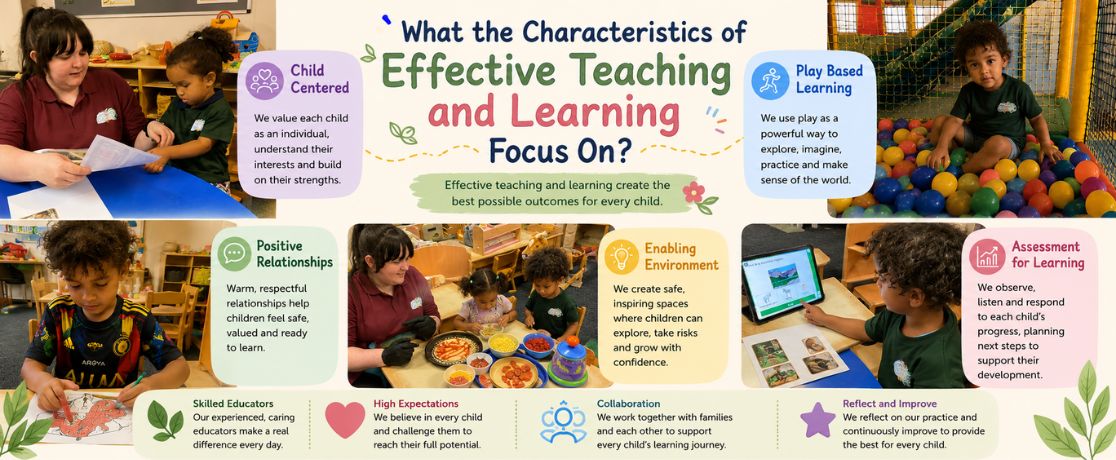
Every parent wants to know their child is doing more than just sitting at a table and filling in worksheets. They want their child to love learning. That is exactly what the characteristics of effective teaching and learning are designed to protect a child's natural drive to explore, persist, and think for themselves.
If you are a parent researching nurseries in Leyland or simply want to understand how early years education works in England, this guide breaks it all down clearly.
What Are the Characteristics of Effective Teaching and Learning?
The characteristics of effective teaching and learning sit at the heart of the Early Years Foundation Stage (EYFS) statutory framework, which governs the education and care of all children from birth to age five in England.
Introduced formally by the Department for Education, these characteristics are now a statutory requirement. Paragraph 1.18 of the EYFS framework states that practitioners must reflect on the different rates at which children develop and adjust their practice accordingly. The characteristics give practitioners the tools to do exactly that.
There are three core characteristics, each focusing on how children learn rather than simply what they learn:
- Playing and Exploring — children investigate and experience things, and "have a go"
- Active Learning — children concentrate and keep trying when they encounter difficulties, and enjoy their achievements
- Creating and Thinking Critically — children develop their own ideas, make links between ideas, and build strategies for doing things
Let's break each one down.
Playing and Exploring: Learning Through Doing
What This Characteristic Focuses On
Playing and exploring is about how a child engages with the world around them. It covers three broad areas:
- Finding out and exploring — children use their senses, follow their own curiosity, and discover things through open-ended play
- Playing with what they know — children act out experiences they have had, representing their understanding through role play and pretend scenarios
- Being willing to have a go — children take risks, try new things, and do not shy away from something just because it feels uncertain
Here is why this matters so much in the early years: children are born curious. A quality setting does not dampen that curiosity it channels it. When a child chooses to prod mud, stack bricks, or pour water repeatedly, they are not just playing. They are forming hypotheses, testing outcomes, and building mental models of how the world works.
The West Sussex County Council's early years guidance notes that risk-taking is a key part of supporting children to learn. A child who feels safe enough to try and fail is a child who will keep trying throughout life.
At Little Mowgli Nursery in Leyland, the team builds daily experiences around this principle giving children access to outdoor spaces, natural materials, and open-ended activities that let curiosity lead.
Active Learning: Motivation and Persistence
What This Characteristic Focuses On
Active learning is frequently misread as physical movement. It is not. Active learning is about a child's motivation whether they stay engaged, push through difficulty, and feel satisfaction from their own efforts.
It breaks down into three areas:
- Being involved and concentrating — deep focus that shows a child is genuinely absorbed in what they are doing
- Keeping trying — bouncing back when something does not work, rather than giving up or waiting for an adult to step in
- Enjoying achieving what they set out to do — the intrinsic reward that comes from completing something through their own effort
The Ambition Institute, a respected education charity, has noted through case study research that when practitioners explicitly model persistence and talk openly to children about how to be a learner not just what to do children develop these traits more reliably. It is not enough to wait and observe; practitioners need to actively teach these attitudes.
This has a direct effect on later schooling. A child who has learnt to concentrate, persist, and take pride in their own work arrives at Year 1 with a significant advantage not because they know more facts, but because they know how to keep going.
Creating and Thinking Critically: Ideas, Connections, and Strategies
What This Characteristic Focuses On
This third characteristic is where cognition really comes to life. Creating and thinking critically covers:
- Having their own ideas — original thinking, imagination, and the ability to come up with something new
- Making links — connecting things they already know to new situations, and spotting patterns across different experiences
- Choosing ways to do things — planning, making decisions, and finding their own strategies rather than always waiting to be told
Scholastic UK describes this characteristic as being about children thinking, making choices, seeing connections between different skills, and making sense of their experiences. That is a rich set of cognitive skills being built during what researchers recognise as the most sensitive developmental window in a person's life.
What does this look like in practice? A child who decides to build a den, figures out the roof keeps collapsing, tries a different approach, and eventually solves the problem that child is doing all three things at once. They are generating ideas, drawing on prior knowledge, and planning strategically.
Why the Characteristics Focus on How Children Learn, Not Just What They Learn
This is the key insight that separates quality early years provision from a setting that simply works through activities.
The EYFS framework, and the research it draws on, is clear: effective teaching in the early years considers the process of learning as much as its content. Children who develop strong learning dispositions early who are curious, resilient, and capable of self-directed thought go on to perform better academically and socially across their school years.
The Birth to 5 Matters guidance, developed by a coalition of sector organisations, frames the characteristics as a "golden thread" woven through all seven areas of learning. Every area from communication and language to expressive arts and design is taught more effectively when practitioners keep these characteristics in view.
Practitioners who understand this look for what researchers call "teachable moments." A child struggling to fit a puzzle piece is not failing. That moment is an opportunity to model persistence, encourage problem-solving, and celebrate effort over outcome.
The Role of the Adult in Supporting These Characteristics
Children do not develop strong learning dispositions in a vacuum. The adult role is active and intentional.
Effective early years practitioners:
- Observe carefully — noticing where a child is engaged and where they disengage
- Respond to individual interests — building on what a child already cares about rather than imposing a fixed agenda
- Model the behaviours they want to see — showing what it looks like to try again, to think aloud, to make a plan
- Create enabling environments — both indoors and outdoors, designed to invite curiosity and allow children to lead their own learning
- Ask open questions — "What do you think will happen?" is more powerful than "The answer is..."
The EYFS framework is explicit that children learn through play, through adult modelling, through observing one another, and through adult-guided learning. A skilled practitioner moves fluidly between all four approaches.
At Little Mowgli Nursery, the staff team works across two dedicated rooms the Tigers and Giraffes rooms as well as an outdoor play area, ensuring that both the environment and the adult interaction support all three characteristics throughout the day.
How These Characteristics Connect to the EYFS Profile
At the end of the Reception year, every child receives an EYFS Profile. This statutory assessment gives Year 1 teachers a rounded picture of each child's development.
Teachers may include a short commentary on each child's skills in relation to the three characteristics of effective teaching and learning. This means the characteristics are not just philosophy they are assessed, documented, and used to plan a child's next steps as they move into Key Stage 1.
For parents, this is worth understanding. When practitioners at your child's nursery talk about whether your child "has a go," concentrates, or comes up with their own ideas they are observing and supporting something that will be formally recognised at the end of Reception.
What Good Provision for These Characteristics Looks Like
Here is a practical checklist for what strong early years provision looks like when these characteristics are genuinely embedded:
- Children choose activities freely for a significant part of the day
- Adults support rather than direct most of the time
- Mistakes and failed attempts are welcomed, not corrected away
- Outdoor spaces are accessible and offer open-ended materials
- Staff talk to children about how they are learning, not just what they are doing
- Planning reflects what children were observed doing and thinking, not just a pre-set topic
- Children are given time to finish what they start
The Ambition Institute case study from Ashby Hill Top Primary School found that making the characteristics explicit talking to children about what it means to be a learner was a turning point in outcomes for all children, especially those who had found school most challenging.
Why This Matters for Parents Choosing a Nursery
If you are choosing a nursery for your child, the characteristics of effective teaching give you a useful lens. Ask prospective settings:
- How do staff respond when a child gets frustrated?
- What does a typical morning outdoors look like?
- How do you plan activities around what children are interested in?
- How do you talk to children about their own thinking?
The answers will tell you quickly whether a setting understands learning dispositions or whether it focuses purely on content delivery.
Little Mowgli Nursery in Leyland welcomes these kinds of questions. The team's nature-inspired, play-based approach built around the EYFS framework puts the characteristics of effective teaching at the centre of daily life for every child.
Frequently Asked Questions
1. What are the three characteristics of effective teaching and learning in the EYFS?
The three characteristics are Playing and Exploring, Active Learning, and Creating and Thinking Critically. Together, they describe how children learn best through curiosity, persistence, and self-directed thinking. They are a statutory part of the EYFS framework for all registered early years providers in England.
2. Are the characteristics of effective teaching and learning statutory?
Yes. They are referenced in the EYFS statutory framework under paragraph 1.18 (2024 edition). All Ofsted-registered early years settings in England, including nurseries, childminders, and school Reception classes, must reflect on these characteristics in their practice and planning.
3. How do practitioners support the characteristics in daily nursery life? Practitioners support these characteristics by observing children closely, responding to individual interests, creating open-ended play opportunities both indoors and outdoors, modelling persistence and curiosity, and asking open-ended questions that encourage children to think for themselves rather than wait for an answer.
4. What is the difference between active learning and physical activity in the EYFS?
Active learning refers to a child's level of motivation and engagement, their ability to concentrate, keep trying, and feel satisfaction from their own efforts. It is not the same as physical movement. A child building a block tower quietly can be demonstrating active learning just as much as one running outdoors.
5. Why do the characteristics of effective teaching focus on how children learn, not what they learn?
Research shows that children who develop strong learning dispositions, curiosity, resilience, and creative thinking perform better throughout school and beyond. The EYFS framework places equal weight on the process of learning and its content because attitudes formed in the early years tend to shape how a child approaches challenges for the rest of their life.
Leyland, PR25 2DY

.svg)