

What to Expect in The Early Years Foundation Stage

Dennis Y
Starting nursery or preschool is a big moment for any family. You drop your child off and wonder: what are they actually doing in there? What are the staff looking for? And what does all this talk about the "Early Years Foundation Stage" actually mean?
Let's break it down. This guide explains what the Early Years Foundation Stage is, how it shapes your child's day-to-day experience at nursery, and what you can expect as a parent.
What Is the Early Years Foundation Stage?
The Early Years Foundation Stage, usually referred to as the EYFS, is the statutory framework that all early years providers in England must follow. It covers children from birth to the age of five, spanning nurseries, preschools, childminders, and reception classes in primary schools.
The framework sets the standards that every setting must meet. It covers learning and development, assessment, and safeguarding and welfare. The most recent version came into effect on 1 September 2025.
The EYFS is not a rigid lesson plan. It is a set of principles designed to make sure children get consistent, high-quality early education wherever they are cared for. Whether your child attends a childminder in a village or a nursery in a town centre, the same foundational requirements apply.
The Four Guiding Principles Behind the EYFS
The EYFS is built around four principles that shape how practitioners work with young children. Here is what they mean in practice:
Every child is unique. Children develop at their own pace and in their own way. A good nursery will not compare your child to others. Staff look at each child as an individual and plan activities around their particular interests and needs.
Positive relationships matter. Children learn best when they feel secure and cared for. The EYFS places strong emphasis on the bond between a child and their key person, the member of staff assigned to get to know your child and be their consistent point of contact.
Enabling environments support learning. The space a child learns in, indoors and outdoors, should be set up to encourage curiosity. Resources, routines, and the people around a child all count as part of the environment.
Children develop and learn at different rates. The framework covers all children, including those with special educational needs and disabilities. There is no single timeline every child must follow.
The Seven Areas of Learning in the Early Years Foundation Stage
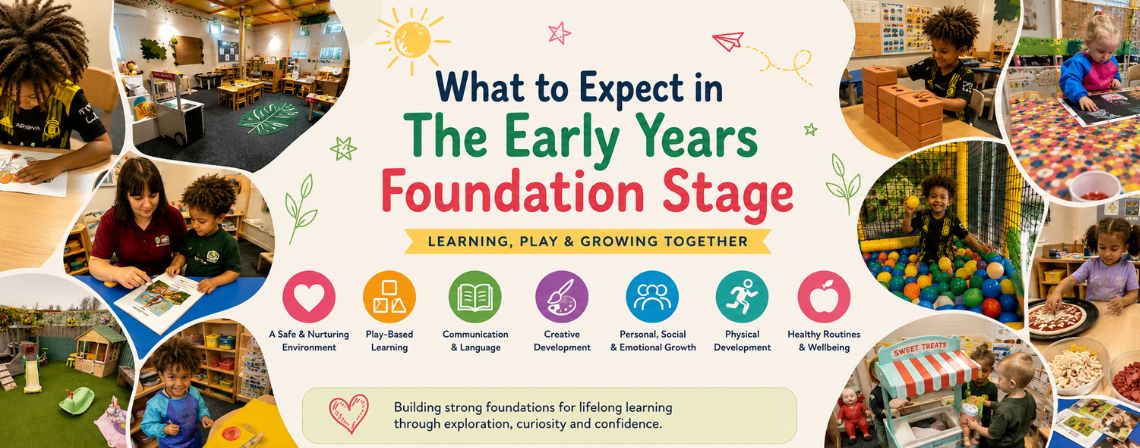
This is where most parents want to know the details. The EYFS organises children's learning across seven areas, split into two groups: three prime areas and four specific areas.
The Three Prime Areas
These come first because they underpin everything else. The EYFS describes the prime areas as those that are most important for building children's curiosity and enthusiasm for learning.
1. Communication and Language This covers listening, attention, understanding, and speaking. At nursery, you will see this in action during story time, group discussions, and one-to-one conversations with staff. Children learn to follow instructions, ask questions, and express their thoughts and feelings in words.
2. Personal, Social and Emotional Development (PSED) This area is about how children manage their own feelings, build relationships, and develop a sense of who they are. It includes learning to take turns, cope with frustration, follow simple rules, and feel confident trying new things. PSED is foundational because a child who feels settled and secure can access all other learning far more readily.
3. Physical Development This covers both large movements, such as running, climbing, and balancing, and fine motor skills such as using scissors, holding a pencil, and manipulating small objects. Time outdoors is a direct part of this. Physical development also includes developing an awareness of healthy habits, including hygiene, rest, and nutrition.
The Four Specific Areas
These build on the prime areas. Once a child has strong communication, confidence, and physical coordination, they are better placed to engage with these subjects.
4. Literacy Literacy in the early years is not about sitting down and copying letters. It starts with a love of books, understanding that print carries meaning, and learning the sounds that letters make (phonics). Staff read aloud regularly and use storytelling, rhyme, and conversation to build children's vocabulary and comprehension.
5. Mathematics Early maths is hands-on. Children count objects, sort shapes, compare sizes, explore patterns, and talk about quantity. A child filling and emptying containers in the water tray is doing maths. A child sorting wooden bricks by colour is doing maths. It rarely looks like a worksheet.
6. Understanding the World This area helps children begin to make sense of the world around them: people and communities, the natural environment, and simple technology. It includes talking about families and traditions, observing plants and animals, and experimenting with cause and effect.
7. Expressive Arts and Design This covers creativity in all its forms: painting, drawing, music, movement, role play, and construction. Children use this area to represent their ideas, process their experiences, and develop imagination. A child building a spaceship out of cardboard boxes is learning just as much here as they are in any structured activity.
How Children Learn: The Three Characteristics of Effective Teaching
Alongside the seven areas, the EYFS identifies three characteristics of effective teaching and learning. These describe how children learn, not just what they learn.
Playing and exploring: Children investigate and experience things, and "have a go." They try things out without fear of getting it wrong.
Active learning: Children concentrate and keep trying when they face difficulties. They feel a genuine sense of achievement when they succeed.
Creating and thinking critically: Children develop their own ideas, make connections between things they already know, and work out strategies for doing things differently.
These characteristics are statutory. Practitioners must plan for them and reflect on them in their practice. At the best settings, you will see all three happening naturally throughout the day.
Assessment in the EYFS: What Practitioners Are Looking For
Parents often ask how their child is being assessed. The EYFS includes two formal checkpoints, but ongoing observation happens every day.
The Two-Year Progress Check Between the ages of two and three, your child's key person will write a short summary of how they are getting on in the three prime areas. This is a progress check, not a test. You will receive a copy and can discuss it with staff. It is also a good opportunity to flag any concerns you have at home.
At the end of the reception year, teachers make a judgement about each child against 17 early learning goals. These goals describe what most children are expected to achieve by the end of their reception year. The results are shared with you and passed to your child's Year 1 teacher.
Day to day, practitioners observe children playing and learning, making notes and taking photos to track progress. This ongoing assessment is called formative assessment, and it shapes how staff plan activities for your child.
Safeguarding and Welfare in the EYFS
Beyond learning, the EYFS sets out clear requirements around keeping children safe. Every registered early years setting must have a designated safeguarding lead, a safer recruitment process for staff, and clear policies for responding to concerns about a child's welfare.
The 2025 version of the framework introduced stronger safeguarding requirements, including new obligations for settings to follow up when a child is absent for a prolonged period and more rigorous safeguarding training standards for staff.
Settings must also meet specific requirements around health, including staff-to-child ratios, food and drink, first aid, and administering medication.
What This Looks Like at Little Mowgli Nursery
At Little Mowgli Nursery in Leyland, the EYFS framework shapes everything from the daily timetable to how the rooms are set up. The nursery runs two dedicated rooms, Tigers and Giraffes, alongside an outdoor play area, each designed to support children's learning across all seven areas.
The play-based curriculum at Little Mowgli is built around children's individual interests. Staff observe what sparks each child's curiosity and plan from there. The nature-inspired approach, with regular time outdoors in all weathers, supports physical development and builds the resilience and curiosity the EYFS prime areas are designed to encourage.
Parents receive updates through the nursery's communication channels, keeping you informed about what your child has been doing and how they are progressing against the EYFS areas of learning.
Tips for Supporting the EYFS at Home
Your child's development does not stop at the nursery gate. Here are practical ways to support the seven areas of learning at home:
- Talk constantly. Describe what you are doing, ask open questions, and listen to the answers. This directly supports Communication and Language.
- Read together every day. It does not have to be long. Ten minutes of shared reading builds vocabulary, comprehension, and a love of books faster than almost anything else.
- Count things in real life. Stairs, apples, socks in the washing basket. Everyday counting is more effective than number drills.
- Let them get messy. Sensory play with water, sand, mud, or dough builds fine motor skills and creativity at the same time.
- Go outside. Parks, gardens, puddles, and even back yards give children opportunities to run, climb, observe, and ask questions about the natural world.
- Follow their lead. When your child is deeply absorbed in something, whether it is building a tower or sorting stones, let them keep going. That concentration is exactly what the EYFS calls active learning.
FAQs: The Early Years Foundation Stage
1. Is the EYFS compulsory for all nurseries in England?
Yes. Every registered early years provider in England must follow the EYFS statutory framework. This includes private nurseries, preschools, childminders, and school nursery classes. Ofsted inspects settings against the framework. If a setting does not meet the requirements, it risks losing its registration.
2. At what age does the Early Years Foundation Stage start and finish?
The EYFS covers children from birth to the end of reception year, typically age five. It does not matter how many hours a week your child attends. The framework applies from the moment a child starts in any registered early years setting until they move into Year 1.
3. What is a key person and why does my child have one?
Every child in a registered setting must have a named key person. This is the member of staff who takes particular responsibility for your child's care and learning, builds a relationship with your family, and is your main point of contact. The key person system is a EYFS requirement because young children settle and learn better when they have a consistent, trusted adult they know well.
4. Does the EYFS apply to childminders as well as nurseries?
Yes, though from January 2024, there are two separate versions of the framework: one for childminders and one for group and school-based providers. Both cover the same seven areas of learning and the same safeguarding requirements. The practical delivery differs, but the standards children are entitled to are the same regardless of setting.
5. What should I do if I am worried about my child's development?
Talk to your child's key person. Early years staff are trained to spot and respond to developmental differences, and the EYFS includes specific requirements around supporting children with special educational needs and disabilities. Raising a concern early means support can be put in place sooner. Your GP, health visitor, or local authority SEND team can also offer guidance alongside the nursery.
Leyland, PR25 2DY

.svg)