

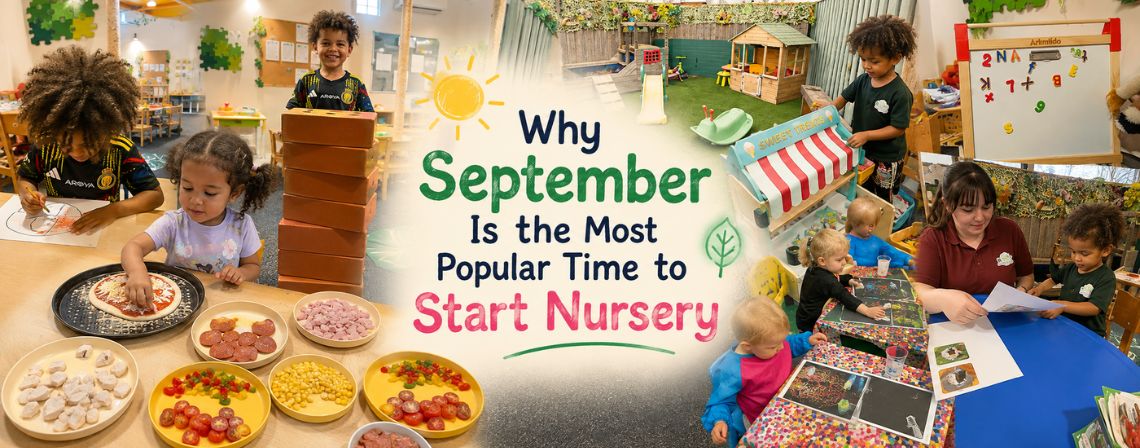
Why September Is the Most Popular Time to Start Nursery

Dennis Y
Every year, as summer winds down and the smell of freshly sharpened pencils fills the air, thousands of families across the UK pack a little bag, take a deep breath, and drop their child off at nursery for the first time. Most of them do it in September. And it is not a coincidence.
September nursery intake is by far the busiest time of year for nurseries, preschools, and early years settings across England. Let's break it down: why does September pull so many families in at once, what does it mean for your child's development, and how do you make the most of it?
How the UK Academic Calendar Shapes September Nursery Intake
The school year in England runs from September to August. That single fact drives almost everything about when children start nursery.
Children typically begin primary school in the September after their fourth birthday. Local authorities run nursery admissions cycles that mirror this academic calendar, with most school-attached nursery classes offering a September start as their main intake point. According to Tower Hamlets Council's admissions guidance, children "will usually start nursery school or a nursery class attached to a primary school in the September following their third birthday."
Private nurseries follow a similar rhythm. The largest turnover periods fall in September, January, and April, when older children move into new rooms and government funding cycles reset. Of these three windows, September sees the biggest wave of new starters, as it sits at the start of the full academic year and gives children the longest possible run-up before they move to Reception.
Parents instinctively feel this too. When school starts in September, it feels natural to begin the nursery years in September as well. It creates a rhythm that the whole family can follow.
Government Funding Kicks In by Term
One of the biggest drivers behind the September surge is money. Here is why this matters.
In England, government-funded childcare hours are released at the start of each term: 1 September, 1 January, and 1 April. As of September 2025, eligible working parents can claim 30 free hours of childcare per week from when their child turns nine months old up until they start school. All three and four-year-olds can also access a universal 15-hour entitlement regardless of parental income or employment.
Because September is the start of the academic year, the September term gives families the longest stretch of funded hours before the next round of applications is due. Parents who sort their nursery place before September get immediate access to their full term of funding. Those who miss the window may wait until January. With childcare costs placing significant pressure on household budgets, September intake is not just convenient. It is often financially smart.
Families in Leyland and the surrounding areas who are considering places at Little Mowgli Nursery can check current availability and fee information directly on the website to understand exactly how funded hours apply to their situation.
Why September Works So Well for Child Development
It is not only logistics that make September the preferred start. There are real developmental reasons why an autumn start suits most young children.
Children are older and more settled after the summer. Children born between September and August age into a new development bracket over the summer. A child who turns two in August will have just reached that milestone when September arrives, rather than starting mid-year at an age that sits awkwardly between developmental stages.
Routines are easier to build from scratch. After a summer of looser schedules, September gives both children and parents a natural reset point. Families set new routines, sleep patterns get adjusted, and everyone expects change. Starting nursery in September fits neatly into this mental reset.
Social development benefits from starting with a peer group. When a child starts in September, they often join a group of children who are also new. Research from the Institute of Education shows that children who attend quality early education settings are better prepared for formal schooling and tend to reach higher academic outcomes later on. Starting together with peers who are also finding their feet helps children form friendships and build confidence without being the "new one" in an already settled group.
It gives the longest settling-in window before school. A child who starts nursery in September at age three will have up to a year and a half before they begin Reception. That is a meaningful amount of time to get comfortable with being away from home, to learn group routines, and to develop the self-regulation skills that Nursery World's research identifies as central to school readiness.
What "Settling In" Actually Looks Like in September
Let's break it down practically. Most nurseries, including Little Mowgli Nursery in Leyland, offer settling-in sessions before a child's official start date. These are short visits, typically one to two hours, where children meet their key worker, get familiar with the space, and begin building trust with the adults who will care for them.
A key worker plays a central role in this process. Under the Early Years Foundation Stage (EYFS) statutory framework, all children in registered early years settings must be assigned a key person whose role is to build a relationship with the child and support their learning and welfare. In September, nurseries often begin their key worker relationships fresh, giving new starters dedicated attention rather than slotting into an already established group dynamic.
Parents often find the first week hardest, not the child. Most children settle faster than expected once they find a familiar face, a favourite activity, or a spot in the outdoor area that feels like their own.
Waiting Lists Fill Up Fast: Plan Ahead for September
Here is where September popularity becomes a challenge. Because so many families target the same intake window, popular nurseries fill their September places quickly. Some nurseries recommend applying 12 to 18 months in advance, especially for baby rooms or full-time places.
For maintained nursery classes attached to primary schools, local authorities set hard deadlines. Stockport Council, for example, requires applications for September 2026 places to be submitted by 31 March 2026. Miss the deadline and you may wait until the January intake.
Private nurseries manage their own waiting lists. Joining one does not guarantee a place, but it does put your child in the queue. The practical advice is to begin visiting nurseries and getting on waiting lists as early as possible, often well before you think you need to.
Next steps: If you are targeting a September 2026 start for your child, contact nurseries in your area now, not in the summer.
What to Look for When Choosing a September Nursery Place
Not all September starts are equal. What matters most is finding the right setting for your child, not just any available space.
When visiting nurseries ahead of the September intake, consider the following:
- EYFS framework compliance. All registered early years settings in England must follow the EYFS, which sets standards for learning, development, and welfare. Ofsted inspects settings against these standards, with 96% of early years settings in England currently rated good or outstanding.
- Outdoor access. Time outdoors supports physical development, resilience, and a love of nature. The World Health Organisation highlights the importance of physical activity in early childhood for cognitive and psychosocial health.
- Staff-to-child ratios. For children under two, the legal minimum is one adult per three children. For two-year-olds it is one to four, and for children aged three and above with a qualified teacher present, it can be one to thirteen.
- Your child's individual pace. Some children are ready to start nursery at two, others settle better at three. There is no single correct answer. Watch for signs of curiosity, a growing interest in other children, and comfort with short separations from you.
September Nursery Intake: A Quick FAQ
Q: When should I apply for a September nursery place?
For school-attached nurseries, check your local authority's deadline, which is often in February or March before the September you want. For private nurseries, apply as early as possible, ideally six to twelve months in advance in high-demand areas.
Q: Can my child start nursery in September if they turn three in August?
Yes. A child who turns three in August becomes eligible for 15 hours of funded early education from the following September term. This makes August-born children natural candidates for a September nursery intake. Contact your nursery directly to confirm their admissions process.
Q: What government funding is available from September?
As of September 2025, eligible working parents can claim 30 free hours of childcare per week from nine months of age up to school start. All three and four-year-olds in England qualify for a universal 15-hour entitlement regardless of parental employment or income. [3]
Q: What is a key worker and why does it matter in September?
A key worker is a named member of nursery staff responsible for building a close relationship with your child, supporting their development, and communicating with your family. Starting in September often means your child gets a fresh key worker relationship from day one, rather than joining an established group mid-year.
Q: How long does it take a child to settle into nursery in September?
Most children settle within two to four weeks, though every child is different. Settling-in sessions before the official start date help speed up the process. If your child is still struggling after six to eight weeks, speak with the nursery's key worker or SENCO about additional support strategies.
Leyland, PR25 2DY

.svg)